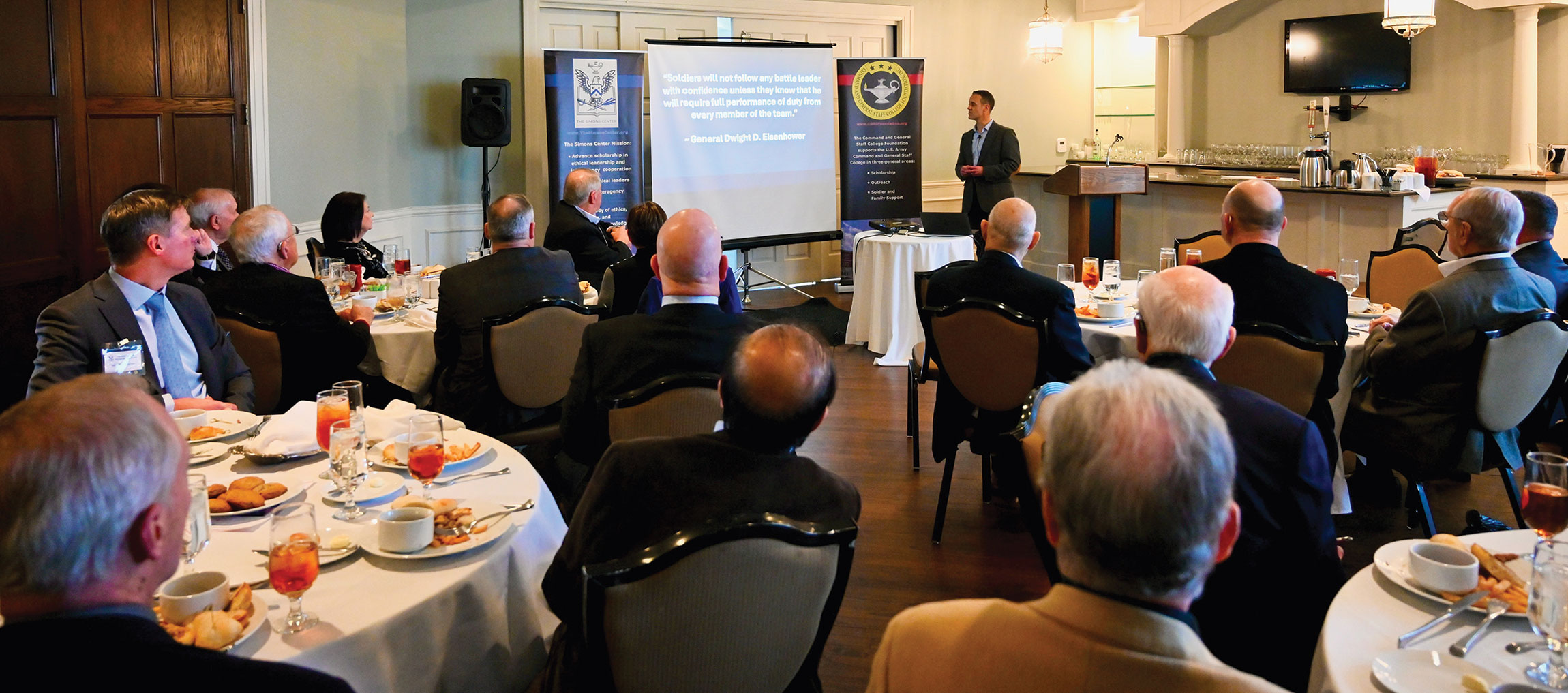
The CGSC Foundation’s Simons Center hosted an Arter-Rowland National Security Forum luncheon event on Jan. 15, 2026, at the Carriage Club in Kansas City. The event featured a presentation entitled “Ethical leadership in crisis situations” by Col. Andrew Steadman, director of the Army University Press at Fort Leavenworth, Kansas.
The CGSC Foundation’s Simons Center Director and ARNSF program leader Col. (Ret.) Todd Schmidt kicked off the Forum welcoming the ARNSF members and their guests. After lunch, he introduced Steadman.
Steadman began his presentation by asking the audience when the last time each of them had a serious conversation about ethical leadership and ethical principals and is ethics a part of their daily lives. To help bridge the gap in time that audience members might have discussed ethical leadership he provided some examples of the definition of ethical leadership, one notably from a 2010 edition of Military Review which read: “Ethical leadership is at the heart of our military profession. Ethical leaders are credible as ethical role models. They bring attention to ethical issues and standards. They create ethical command climates.”
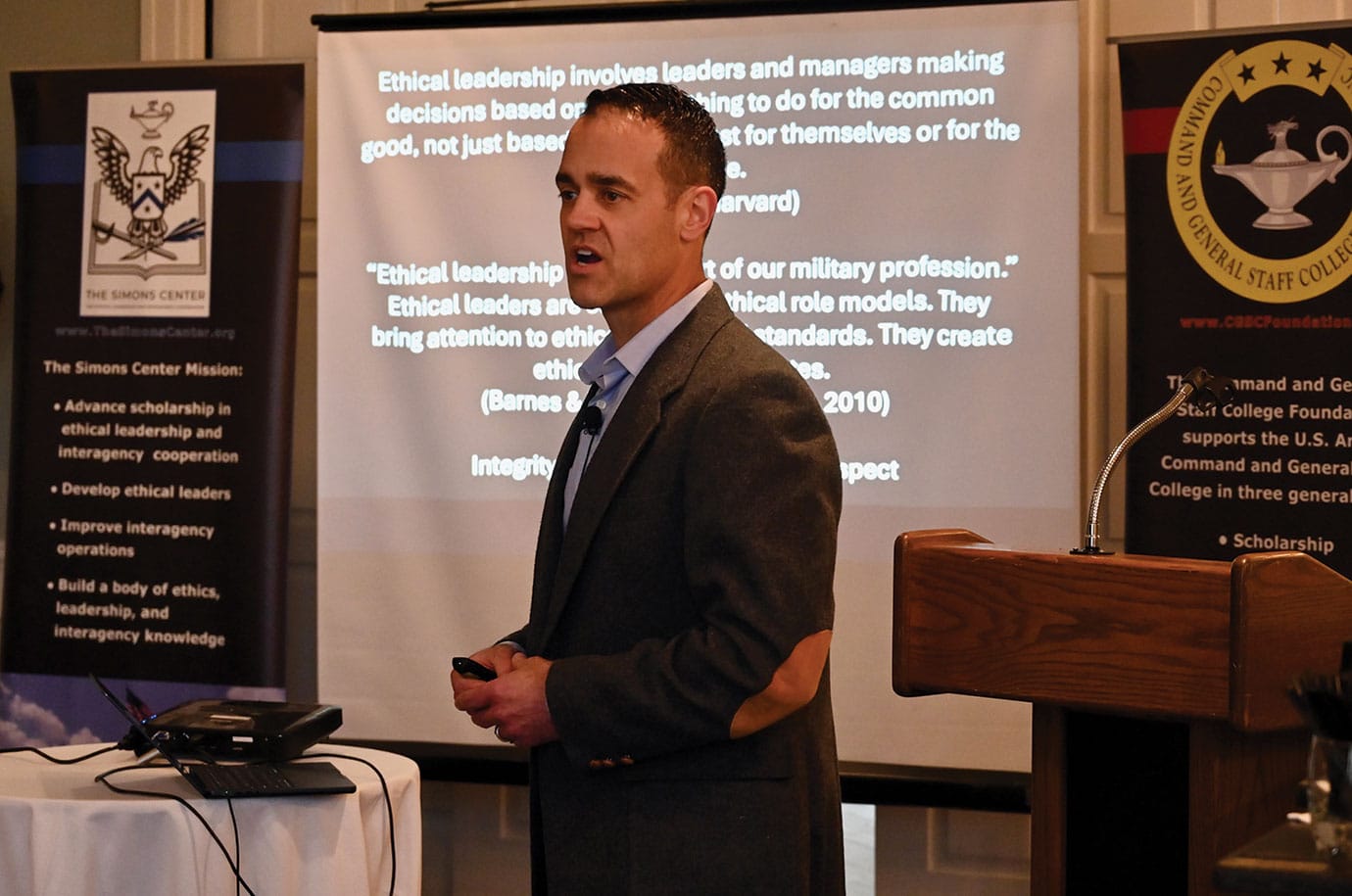
Steadman added that ethical leadership has many aspects including integrity, honesty, fairness and respect…and also empathy.
“Leaders typically come with a dose of empathy and understanding for what consequences come with their decisions,” Steadman said.
Steadman then went on to describe his responsibilities during his assignment as a military aide to the White House where he and the other military service aides were charged with carrying what has become known as the “nuclear football” and being prepared to assist the president in making a decision to launch nuclear weapons. A decision, Steadman said, that is likely the most ethically challenging one could imagine. He then showed a short clip from the movie House of Dynamite where the fictional president was with his military aide going through that decision process.
He talked about his other responsibilities as a White House aide showing photos of his team and other events during that time. He said perhaps the most humbling moments during that assignment was assisting the president with presenting the Medal of Honor four times and having his promotion ceremony to lieutenant colonel conducted in the Oval Office.
Steadman said those experiences combined with his experiences in Iraq led him to creating a personal framework for leading through crisis. The first step in his framework is for the leader to set the emotional tone, second, configure the organization for crisis, and finally, define reality. When considering crisis leadership through a moral or ethical lens, Steadman said you should set a tone that not only calms, but guides people though an adherence to some principle or moral code. In configuring or directing the organization during the crisis, leaders should consider ethical bounds that keep them in line.
In the flood of information around us, Steadman asked whether we can find ethical leadership. He said we can all find situations where our personal morality should take over and we have to question what things can we change in our lives. He offered a simple model of how we look at the world around us through three lens: the lens of “self” – how we look at the world through our own ideas of moral and ethical grounding; through the lens of the organization or leader we work for or with; and finally through the lens of some higher or broader perspective, possibly a deity. Through these three lens, we can make sense of all the “noise” around us, he said.
Steadman provided more examples of ethic situations through movie and news clips, and ultimately challenged the audience with two questions: In what ways might you need to refresh your ethical foundation? As an ethical leader, what does your team need to hear from you?
After the presentation and a question and answer period, Schmidt presented Steadman with a small gift in appreciation for his time with the Forum. Schmidt also provided information about future ARNSF gatherings.
For more photos see the CGSC Foundation Flickr album
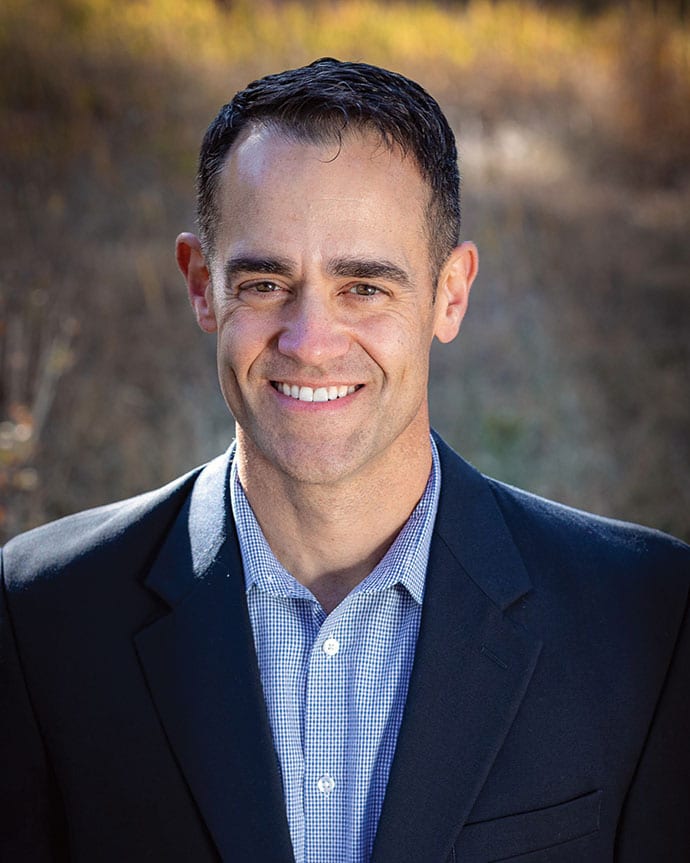
Col. Andrew Steadman assumed duty as the director of Army University Press at Fort Leavenworth, Kansas in July 2025.
Prior to this assignment he served in a variety of leadership positions in the Army including command of the 1st Stryker Brigade Combat Team of the 4th Infantry Division at Fort Carson, Colorado, and command of the 1st Battalion, 23rd Infantry Regiment at Joint Base Lewis-McChord, Washington. He has deployed to combat five times.
Steadman’s other notable Army assignments include serving on the faculty of the U.S. Army War College from 2020-2022 and as a senior trainer at the National Training Center at Fort Irwin, California from 2019-2020. From 2015 to 2017, Steadman served as a Military Aide to the President of the United States, where he coordinated military support, assisted in official functions such as Congressional Medal of Honor presentations, and carried the “nuclear football.”
Steadman is also a TEDx speaker, author, and certified John Maxwell Leadership Team coach/trainer, which all feed into his passion of developing leaders for nearly three decades. As a DISC-certified behavioral analysis consultant, Steadman provides leaders with valuable insights into communication styles, team dynamics, and conflict resolution. He has delivered keynote addresses and mastermind workshops to leaders across industries. Most recently, he delivered a TEDx talk titled “How to Lead Through the First Ten Minutes of Any Crisis,” where he shared battle-tested crisis leadership strategies drawn from his military experience. He also addressed the Military Mentors “Moment Conference,” inspiring leaders with hard-earned lessons from combat to the White House.
He published his first book in 2018 – The Military Leader: Fundamental Insight Into Developing Leaders. His thought leadership has been featured in Inc. Magazine, Military Review, Army Magazine, and the books Why We Write: Craft Essays on Writing War and Maximizing Senior Leader Health and Wellbeing.
A native of Atlanta, Georgia, Steadman has graduated from the United States Air Force Academy, the U.S. Army Command and General Staff College, and the U.S. Army War College. He is married and has two daughters.
The Arter-Rowland National Security Forum (ARNSF) is an
exclusive professional information sharing and networking program.
The Arter-Rowland National Security Forum is an exclusive professional information sharing and networking event exclusively for members of the forum and select invitees of the CGSC Foundation and its Simons Center .
Members of the Forum and their guests meet periodically at guest speaker events in downtown Kansas City. National and regional guest speakers representing all elements of national power (Diplomatic, Informational, Military and Economic) highlight the meetings. The Forum is nonpartisan, but elected government officials may present from time to time.
The Forum is named after Lt. Gen. (Ret.) Robert Arter, Founding Chairman of the CGSC Foundation, and Mr. Landon Rowland, the Foundation’s first major donor who was well-known in Kansas City for his keen interest in national security issues and his leadership in business and philanthropy.
ARNSF events are only open to ARNSF members and their guests. If you are not a member but are interested in joining, contact the CGSC Foundation.
The Arter-Rowland National Security Forum is sponsored by: