
The U.S. Army Command and General Staff College and the CGSC Foundation cohosted the 2026 CGSC Military Ethics Symposium March 27, 2026 at the Lewis and Clark Center on Fort Leavenworth.
The theme of this year’s ethics symposium was “Civil–Military Relations Since World War II: Ethical Considerations,” with particular focus on the ethical challenges that emerge in times of crisis.

The keynote presenters were the CGSC Foundation’s General Hugh Shelton Distinguished Visiting Chair of Ethics, Paul David Miller, Ph.D., who is also a professor at Georgetown University, and Kori Schake, Ph.D., a senior fellow and the director of foreign and defense policy studies at the American Enterprise Institute. Participants included the CGSOC students in the current class of 2026, faculty, and the ethicists from the various centers of excellence around the Army that report to the Combined Arms Command.
Chaplain (Lt. Col.) Derek Pottinger from the CGSC Department of Command and Leadership, and CGSC Foundation President/CEO Lora Morgan kicked off the symposium with welcome remarks. Following the welcome, CGSC Commandant Col. Ethan Diven spoke.
In his opening remarks Diven described Army stewardship of the profession of arms as a necessity that must ensure that our military dominance is surpassed only by our moral conduct. Following Diven was Miller, who presented the first of two keynote addresses for the symposium. In his presentation, “Judgment in the Moment: Ethics and Responsibility in the Profession of Arms,” Miller exhorted the audience to consider the formation of character in order to be prepared for the day in which laws are ignored, foolish orders given or legal ones violated.
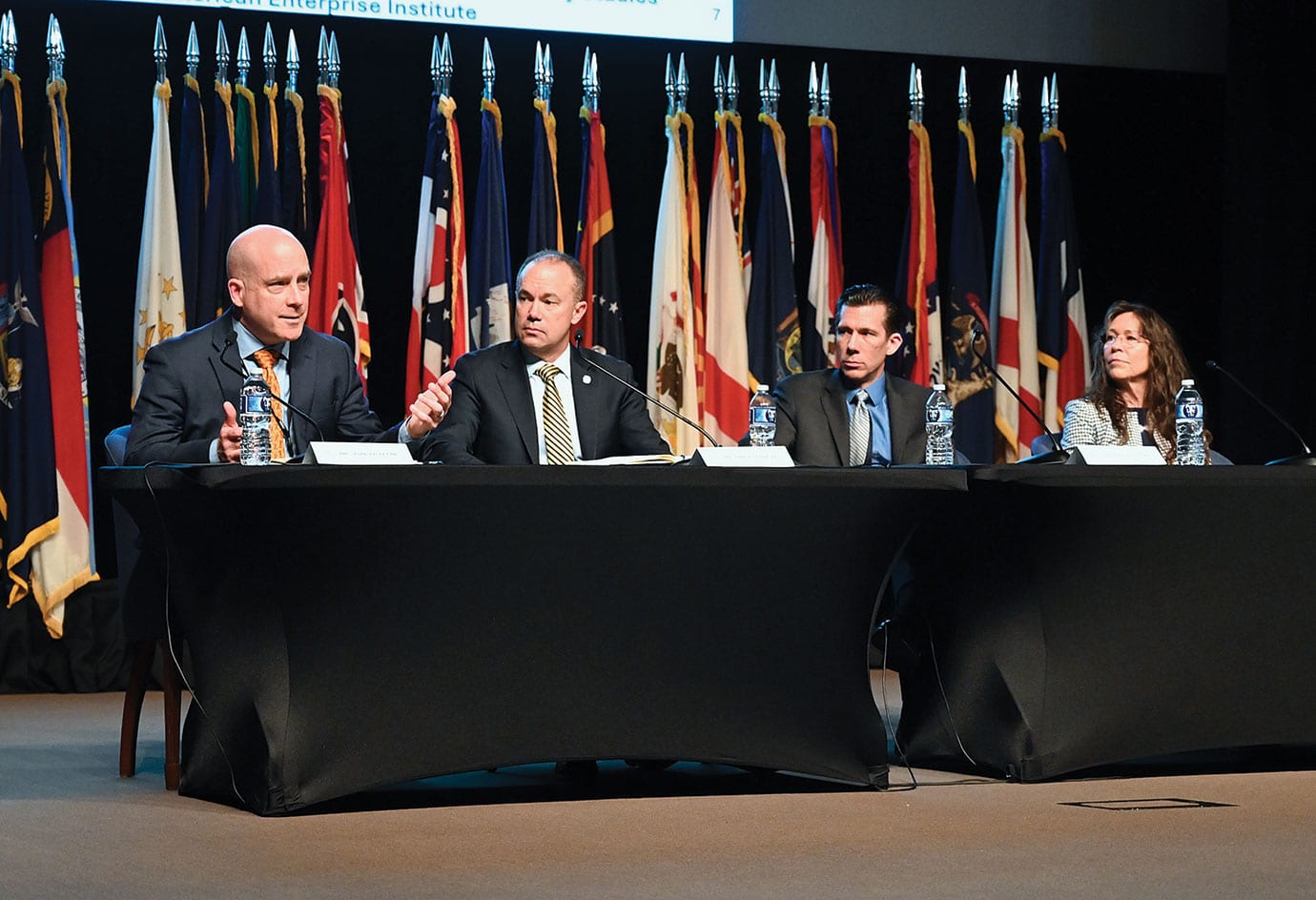
After his remarks, Miller participated in a panel discussion with Schake, Eric Patterson, Ph.D., president/CEO of the Victims of Communism Memorial Foundation, and Marc LiVecche, Ph.D., the McDonald Distinguished Scholar of Ethics, War, and Public Life at Providence, non-resident research fellow at the U.S. Naval War College, and adjunct professor of ethics at the U.S. Naval Academy.
During the panel discussion, LiVecci described the connection between physical fitness, mental agility and moral formation as the habitual creation of space to make moral decisions. Patterson contributed to the discussion from the perspective of a leader whose identity and calling sets the conditions to form moral character within the organization.

After the first panel discussion, Schake provided her keynote presentation. In both the panel discussion and her keynote, she highlighted significant challenges within the civilian-military relationship. She pointed to some civilians’ desire to use the trusted status of the military for partisan advancement as of special concern for our students. Her case study of President Andrew Johnson and General Grant’s relationship during the reconstruction period after the Civil War was central to her argument of why our non-partisan civilian-military relationship is unique and essential to the fabric of the United States.
The final panel was led by CGSC Director of the Department of Command and Leadership, Michael Forsyth, Ph.D., along with Trent Lythgoe, Ph.D., associate professor of military leadership and the Fox Conner Chair for Leadership Studies, and John Modinger, Ph.D., associate professor in CGSC’s Department of Joint, Interagency, and Multinational Operations. The three discussed issues related to Army officers’ responsibility to remain apolitical, non-partisan and politically “astute” with respect to the implications their oath of office, selfless service, and the practical career decisions they make in and out of uniform.
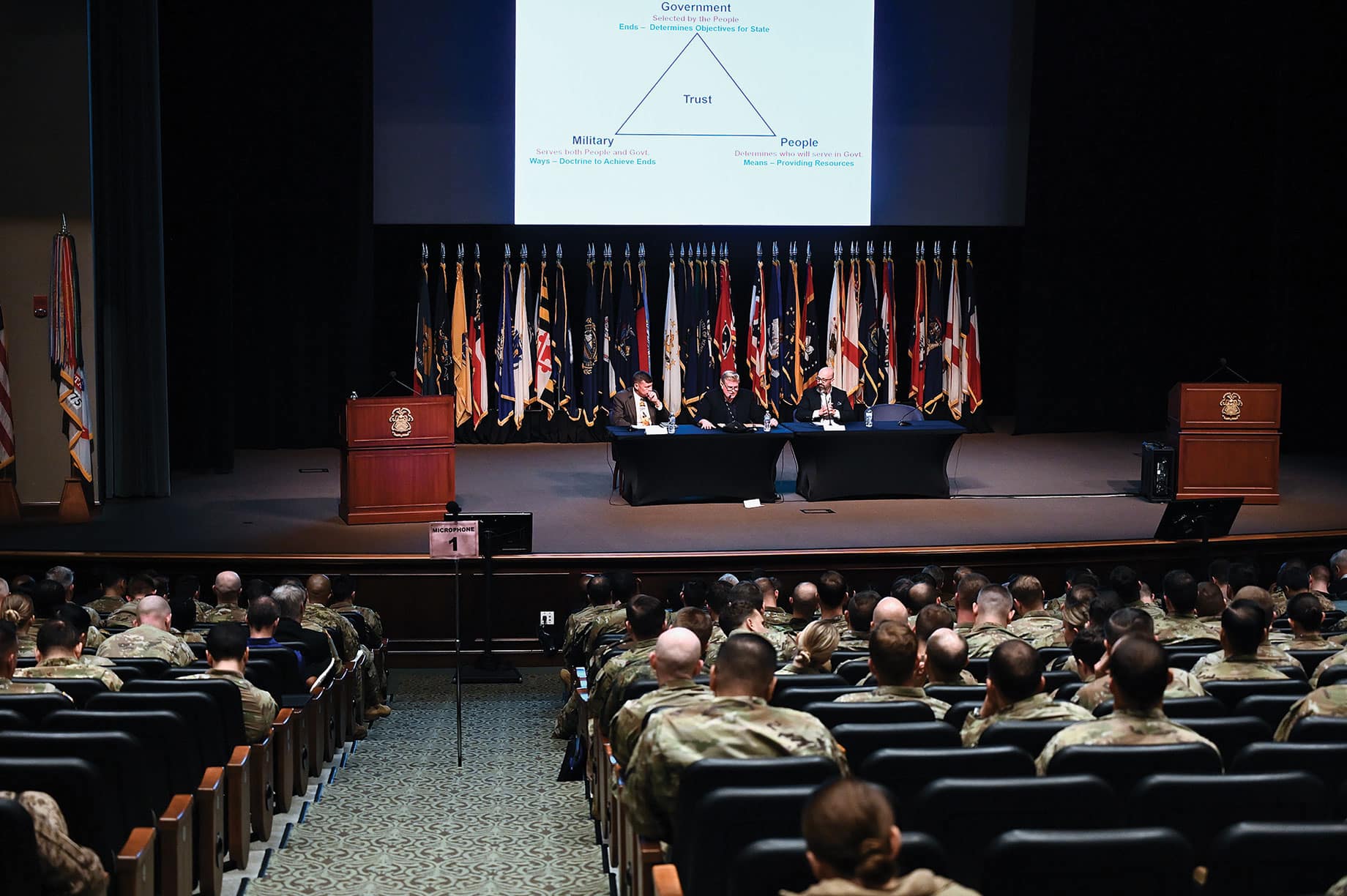
After the final panel discussions, symposium attendees had the opportunity to attend breakout sessions for presentations on papers submitted for the symposium by CGSC student authors and U.S. Army chaplain ethicists. The presentations were:
“Gallows Humor, Sacred Conscience: The Ethics of Medical Experiments on Conscientious Objectors in WWII” and “Just War and the Virtuous Physician” by Chaplain (Maj.) Andrew Schmitz, bio-ethics advanced civil schooling student at Southern Baptist Theological Seminary, Louisville, Ky.
“MacArthur: A Cautionary Tale in Civil-Military Breakdown” by Chaplain (Col.) Sean Wead, deputy command chaplain, U.S. Army Training and Transformation Command, Austin, Texas.
“Just War Tradition and Ethical Frameworks: Are They Relevant in an Age of Autonomous Weapon Systems?” by Chaplain (Maj.) Vincent Bain, bio-ethicist, Walter Read Medical Center, Washington D.C.
“Building an Ethical Framework for Intelligence Operations” by Chaplain (Maj.) Brett Newman, chaplain ethicist, U.S. Army Non-Commissioned Officer Academy, Fort Bliss, Texas.

“Joan of Arc – the Example of Harmony of Just War Tradition and Divine Command” by Chaplain (Maj.) Ben Reed, chaplain ethicist, U.S. Army CBRN School, Fort Leonard Wood, Mo.
“Just War Theory and Moral Injury” by Chaplain (Maj.) Glen Thompson, chaplain ethicist, U.S. ARMY Cyber Center of Excellence, Fort Gordon, Ga.
“The Chaplain as a Faithful Civil-Military Steward of the Army Profession” by Chaplain (Maj.) Mike Demmon, chaplain ethicist, U.S. Army Military Police School, Fort Leonard Wood, Mo.
“Renewed Moral Ownership in Just War Uncertainty – Ethical Foundations as Preventers of Moral Injury” by Chaplain (Maj.) Jason Garlock, chaplain ethicist, U.S. Army Maneuver Center of Excellence, Fort Benning, Ga.
“Rights Based Ethics and the Just War Theory” by Chaplain (Maj.) Hank Mauterer, chaplain ethicist, U.S. Army Institute for Religious Leadership, Fort Jackson, S.C.
“The Eyes of the World are Upon You: Just War Norms for Normandy” by Chaplain (Maj.) Jon Butler, chaplain ethicist, U.S. Army Medical Center of Excellence, Fort Sam Houston, Texas.
“Never [Just] War Again: The Papacy’s Changing Pastoral Voice on Just War” by Chaplain (Maj.) Matthew Whitehead, chaplain ethicist, U.S. Army Adjutant General School, Fort Jackson, S.C.
“The Challenges Presented by World Religions During Large-Scale Combat Operations,” by Chaplain (Maj.) Paul Roman, world religions chaplain and deputy garrison chaplain, U.S. Army Garrison Daegu and Area IV, Korea.
The CGSC Foundation has provided the resources and support required for the General Hugh Shelton Distinguished Visiting Chair of Ethics, annual ethics symposia and other ethics-related programs for CGSC since 2009.
For more photos see the CGSC Foundation Flickr album
Get CGSC Foundation Email News
Get CGSC Foundation news delivered weekly to your inbox
Simply enter your name & email address below and click the subscribe button…





Leave a Reply