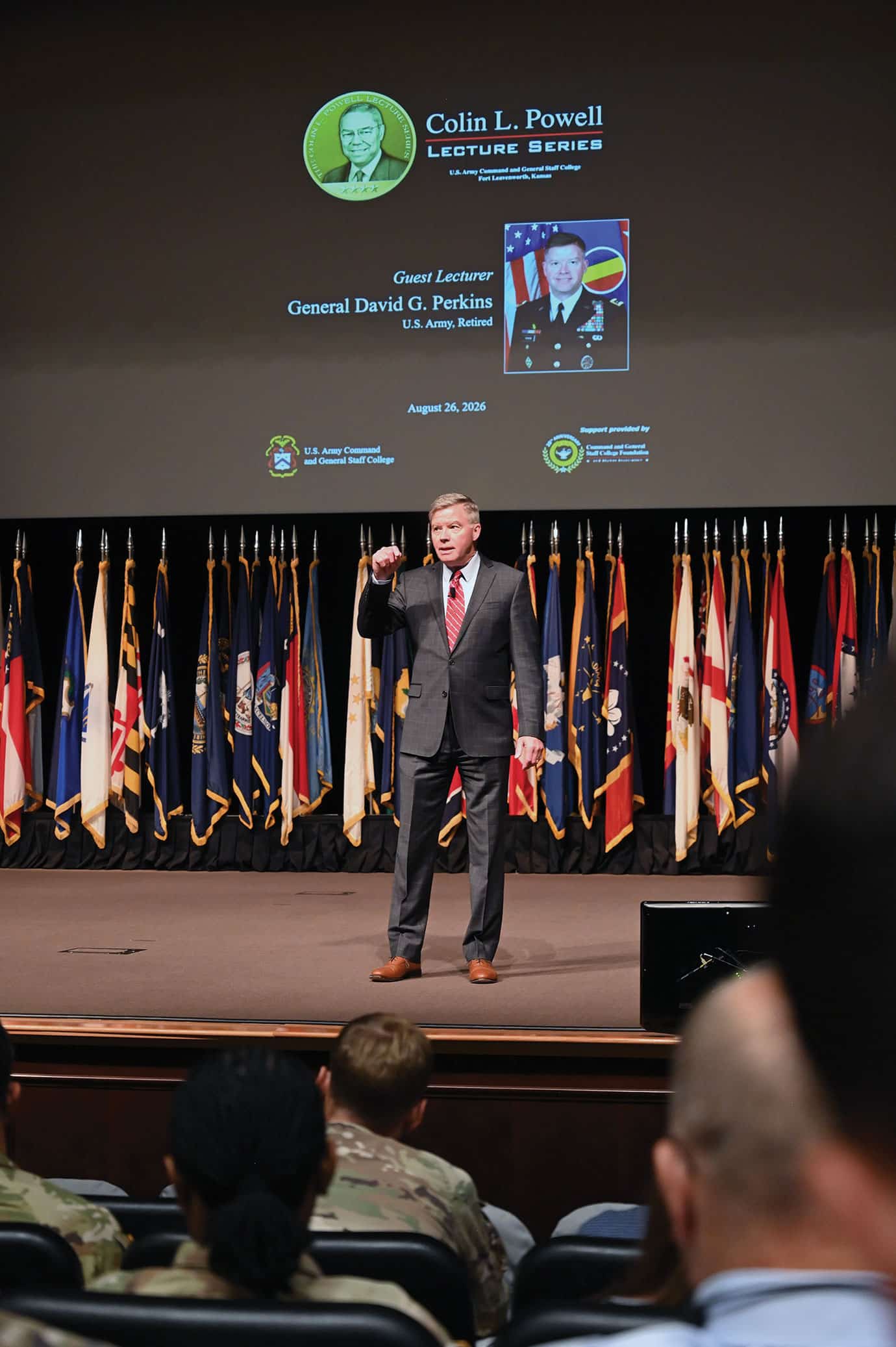
Retired U.S. Army Gen. David. G. Perkins presented “What is a Major For?” as the guest lecturer for the annual Colin L. Powell Lecture Series Aug. 26, 2026, in the Lewis and Clark Center on Fort Leavenworth, Kansas.
“Don’t take [CGSC] for granted,” Perkins said, addressing the students of the Command and General Staff Officers Course [CGSOC] of the Class of 2027. “Make great use of it and know that the reason the Army does it is because you are so critical to what the Army is doing today and what the Army is going to do in the future. In some ways you are disproportionately influential.”
Perkins went on to explain that the students coming out of the U.S. Army Command and General Staff College (CGSC) have more potential and will have more opportunities to shape the largest service in the United States than they really should be allowed to have. He told the story of how the Airland Battle Doctrine was implemented by training and educating the majors, the students, at CGSC. The intent was that after the course they would go out into the Army to help teach the new doctrine at the unit level, thereby transforming the whole Army. So, in the end, Perkins said, what majors in the Army are for is to drive change in the Army at scale. More than a thousand students graduating each year bring the new ideas to the force to help grow and change the Army.
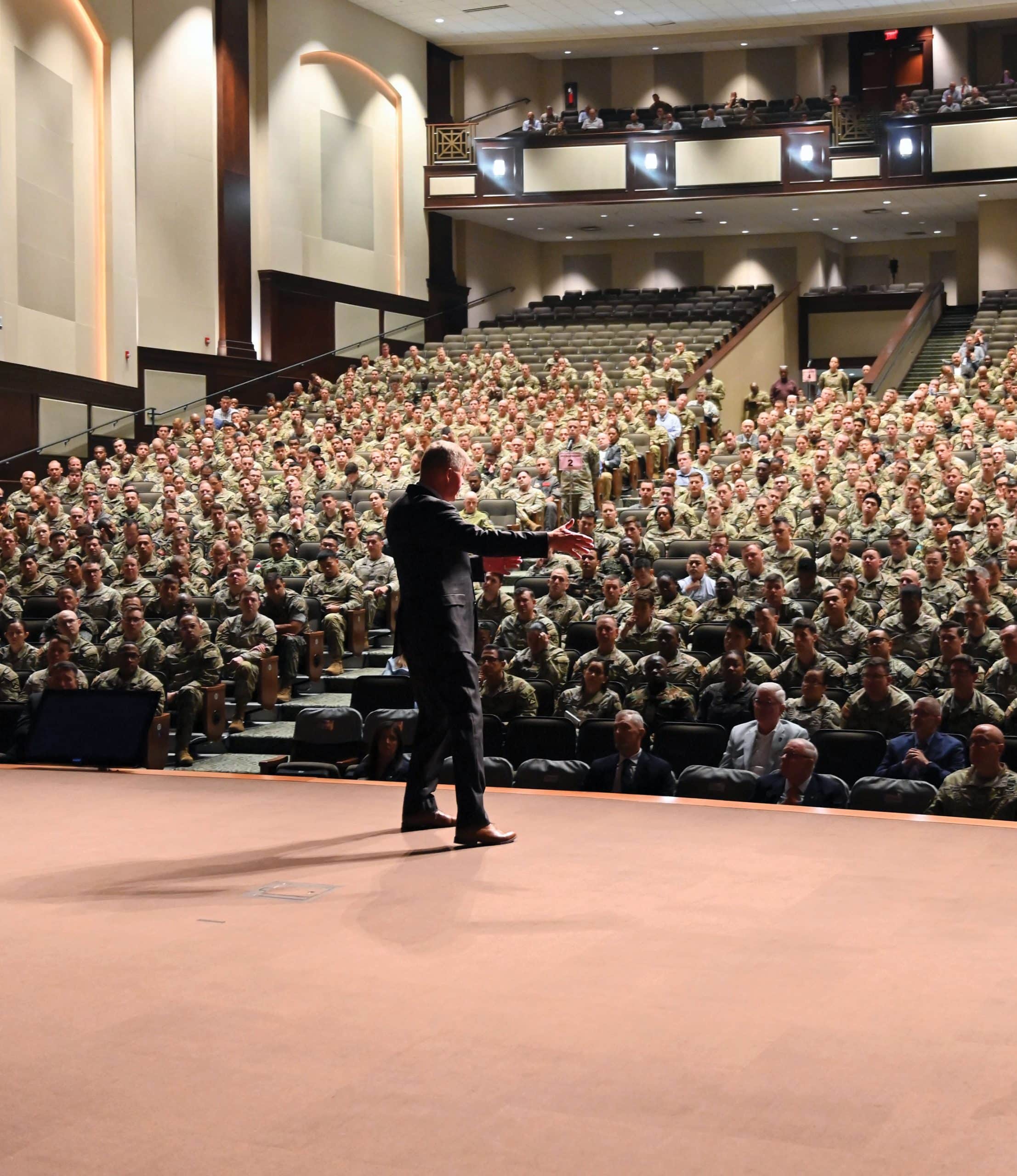
Perkins also described what a “major is for” using a deployment example from his time as a brigade commander in Iraq. He said majors have to figure out what their organizations can do on their own versus what they need help from others to accomplish the mission. “[Majors] run the processes,” Perkins said. “They run the planning processes, they understand the line and block diagrams – both the official line and block diagram and the unofficial line and block diagram.”
“Now that you’re a young field grade officer, what you have to start transitioning is to not only be a master of your branch, but also understanding what your branch brings to the fight and how it interfaces with the enterprise,” Perkins said. He explained this transition using an example of how he once had to prepare the Chairman of the Joint Chiefs of Staff on an issue that he knew intimately, but of course the chairman did not. He said he had to explain the details in a usable way for the chairman, which illustrates the need for staff officers to not only be able do the staff work, but to also be the translator for it and prepare senior leaders so they can engage at their level.
“What you are for” Perkins said is to drive change. How you accomplish “what you are for” is to run the battle staffs at brigade and division level.
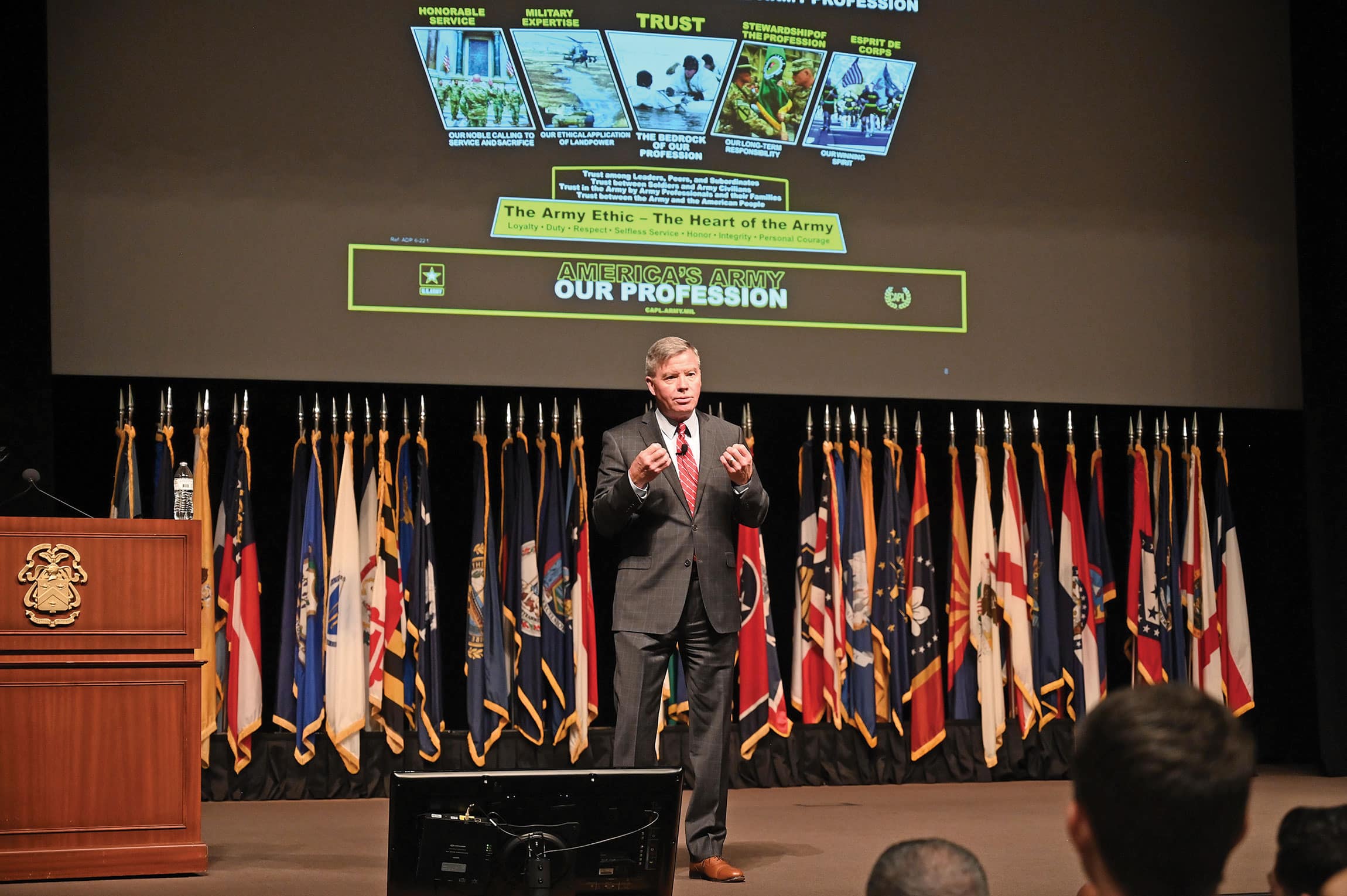
Perkins took questions from the students for a period of time and then concluded with one briefing chart about the Army Profession and Ethic. He said while his main presentation was about what majors were for, the bigger picture of what Army officers are for in general is to be the stewards of the profession. Using a discussion he had during a deployment with a foreign general as a guide, Perkins spoke about the essential characteristics of the U.S. Army profession: honorable service, military expertise, trust, stewardship of the profession and espirit de corps.
At the conclusion, CGSC Foundation Chair Maj. Gen. (Ret.) Chris Hughes along with Command and General Staff School Director Col. Richard Ikena, presented Perkins with a Colin L. Powell Lecture Series commemorative coin from the Foundation in appreciation for his presentation.
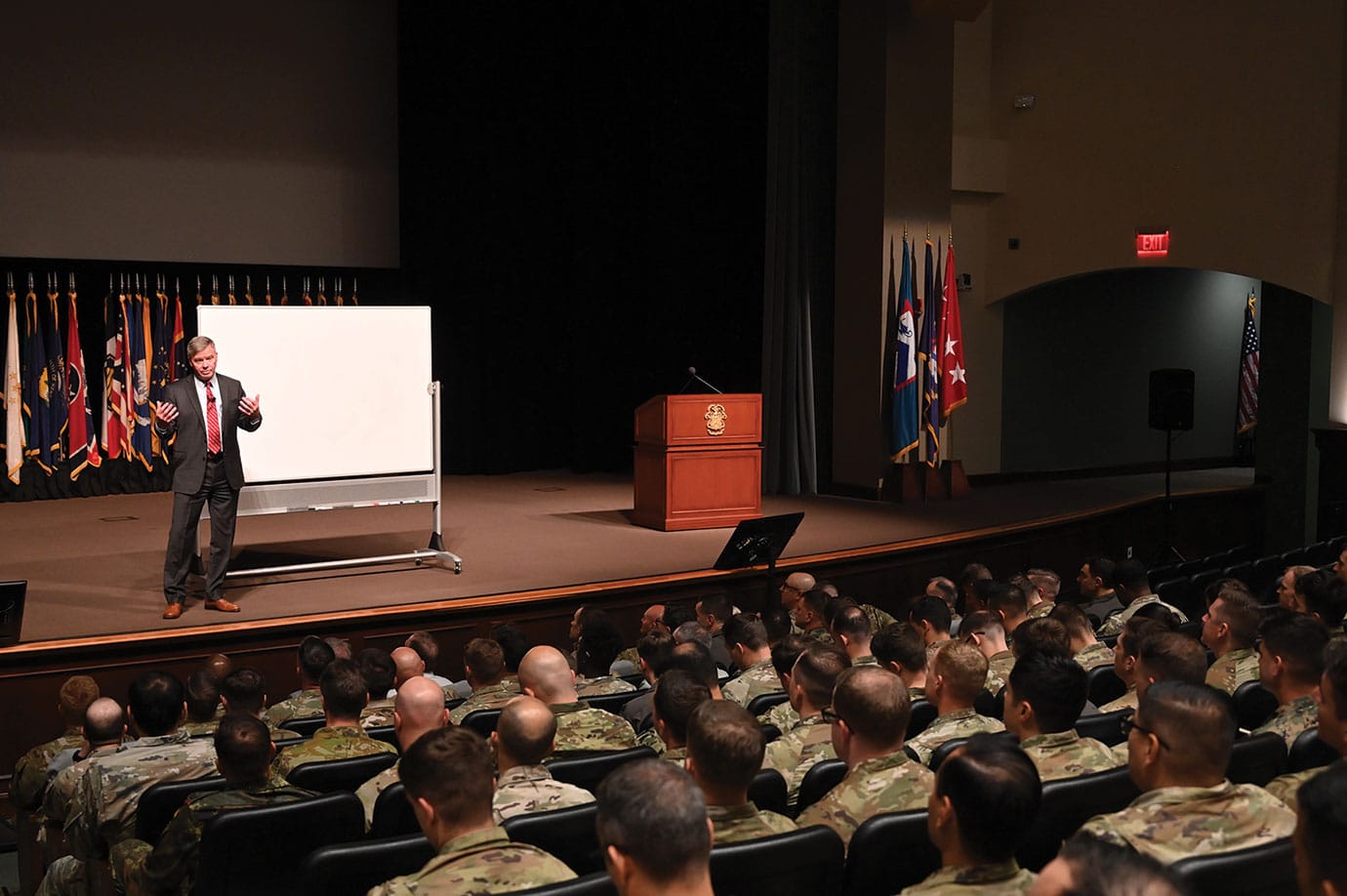
After presenting the Colin L. Powell Lecture Perkins spoke with students in the School of Advanced Military Studies Class of 2027.
After his time with the students, Perkins conducted an office call with CGSC Commandant Col. David Norris, and later with Gregg Thompson, deputy to the commanding general, at the Combined Arms Command headquarters. Later that evening he was the keynote speaker for the CGSC Foundation’s Colin L. Powell Lecture Series Dinner in downtown Kansas City.
Foundation Chairman Maj. Gen. (Ret.) Chris Hughes introduced Perkins at the dinner event after explaining what the CGSC Foundation is “for.”
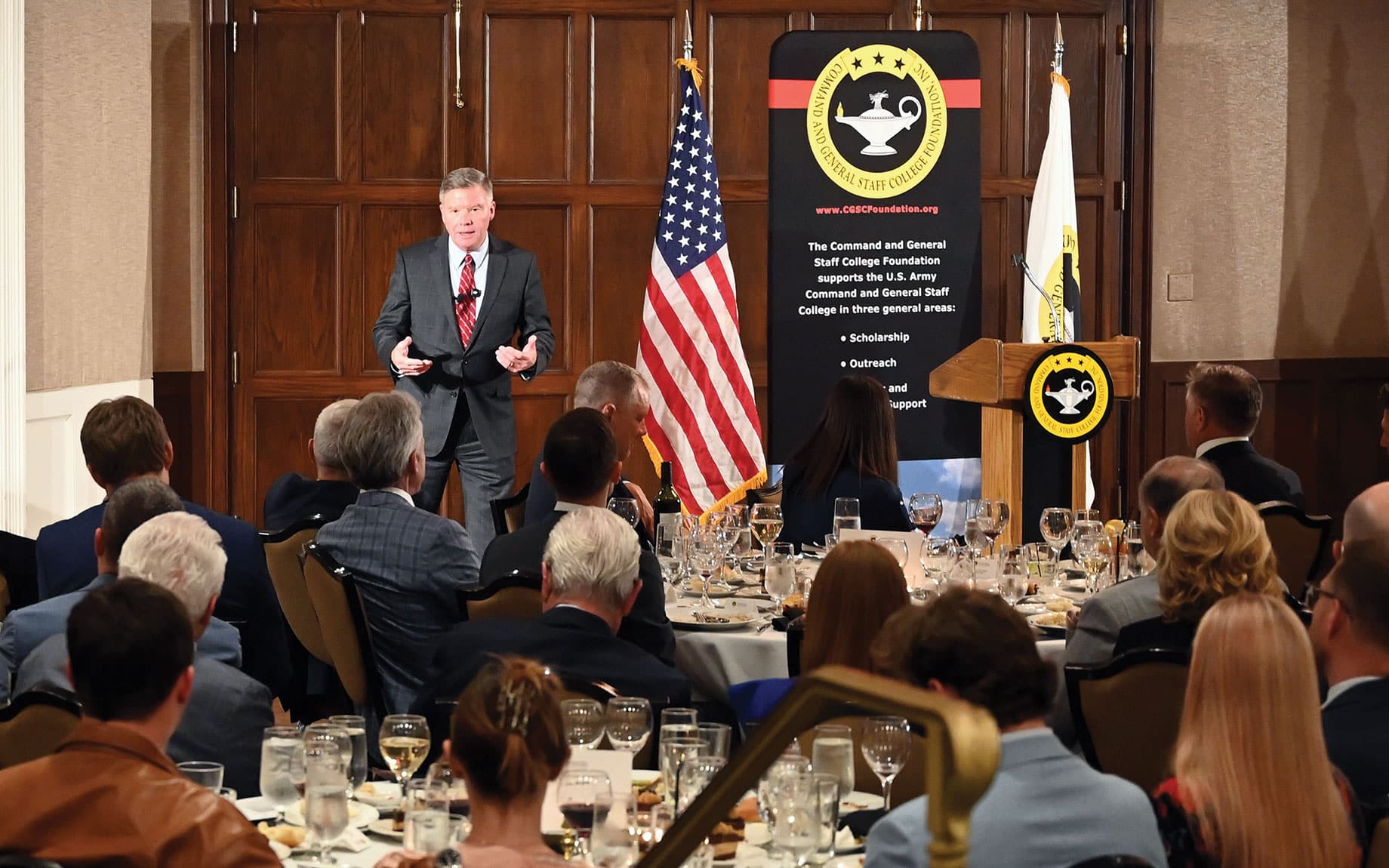
“The CGSC Foundation’s purpose is to make them successful,” Hughes said, pointing at a table of CGSC students who attended the event. “If we can make them successful, they will enable everyone in this room to do whatever you deserve to do as an American citizen.”
After his description of the Foundation mission, Hughes introduced Perkins saying he remembered Perkins’ guidance to him when he worked for him in his last assignment at the Army Recruiting Command and Perkins was his boss as the commander of the U.S. Army Training and Doctrine Command.
“Always, always, do what is right,” Hughes said Perkins told him. “And that has stuck with me to this day. That is the character of the man we have here tonight.”
Perkins centered his remarks at the dinner around a general topic he called “Your Army Today.” But he centered his comments around Fort Leavenworth and how he came to believe that Fort Leavenworth, and by extension, the U.S. Army Command and General Staff College, is the heart and soul of the Army.
Perkins spoke about an experience he had with a foreign military service chief who couldn’t believe how the U.S. Army culture encouraged young leaders not to hide problems, but to highlight them and what they would do to avoid the same problems in the future. Perkins said he thought to himself, “That culture comes from Fort Leavenworth.”
Perkins described how the Army brings majors together at CGSC and then send them back out into the Army and where they inculcate that learning culture into the entire Army. He said he learned a lot by seeing an after-action review through the foreign general’s eyes and realizing that he had taken this culture for granted.
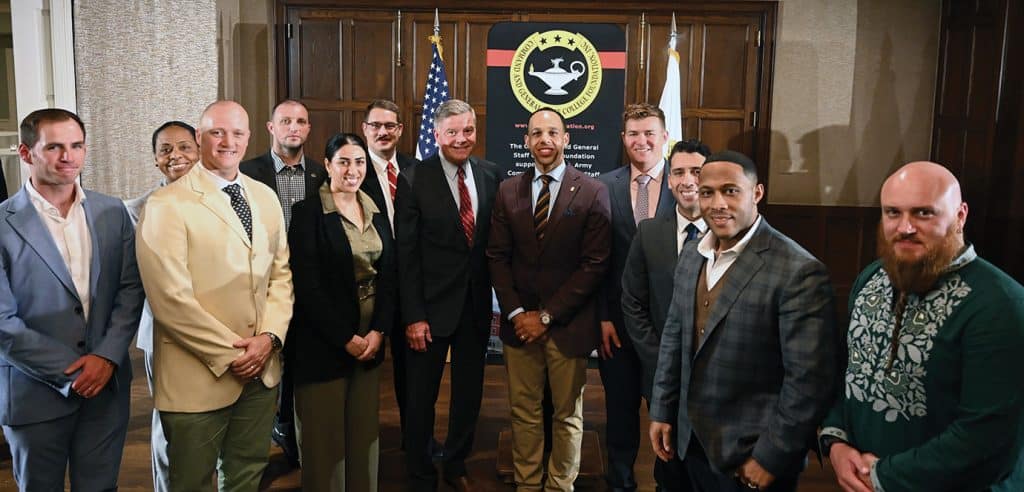
After the Q&A period with the audience, CGSC Foundation President/CEO Lora Morgan presented Perkins with a Fort Leavenworth Lamp statuette in appreciation for his time with the Foundation and its guests. The evening concluded with the Foundation’s Simons Center Program Director Col. (Ret.) Todd Schmidt and Deputy Director Lt. Col. (Ret.) John Nelson leading the attendees in singing The Army Song.
The CGSC Foundation thanks all the sponsors of the dinner event. Special thanks also go to Col. (Ret.) Todd Schmidt and his company Logistics Systems, Inc. (LSI) for sponsoring the Foundation’s welcome dinner for Perkins, sponsors and other special guests at the River Club in Kansas City on Aug. 25, 2026.
General David G. Perkins, U.S. Army, Retired, served as the 15th commander of the U.S. Army Training and Doctrine Command (TRADOC) responsible for designing, acquiring, building, and constantly improving the U.S. Army. While at TRADOC, he led the efforts to develop and publish both the doctrine of Mission Command and the concept of Multi-Domain Operations. Perkins retired in 2018 after 42 years of distinguished active-duty service.
Perkins previously served as the 21st commander of the U.S. Army Combined Arms Center and Fort Leavenworth and commandant of the U.S. Army Command and General Staff College from November 2011 to February 2014, where he was the lead for synchronizing leader development across the Army, the management of the Army’s training support and training development enterprises, and the development and integration of the doctrine the Army uses to fight and win our Nation’s wars.
Perkins also served as the commanding general of the 4th Infantry Division (Mechanized) and U.S. Division North in Iraq. Prior to that command he served as the brigade commander for the 2nd Brigade, 3rd Infantry Division (Mechanized) during the invasion of Iraq, commanding the unit’s “Thunder Run” into Baghdad that led to the fall of the regime.
Perkins was commissioned into the armor branch upon graduation from the U.S. Military Academy at West Point in 1980. In addition to the assignments previously noted, he held leadership positions in armor and mechanized infantry units in Europe, the United States, and the Middle East. He has led and commanded at every level in the Army from platoon leader through division and four-star major Army command. He also held a number of key staff assignments, including deputy chief of staff for strategic effects for Multi-National Forces-Iraq, deputy chief of staff for Operations for U.S. Army Europe, and special assistant to the Speaker of the House, U.S. House of Representatives.
Perkins holds a bachelor of science from the U.S. Military Academy, a master’s in mechanical engineering from the University of Michigan, and a master’s in national security and strategic studies from the U.S. Naval War College. He has received multiple awards and decorations to include the Silver Star and Bronze Star with oak leaf cluster.
For more photos see these albums on the CGSC Foundation Flickr site:
CGSOC Class of 2027 Colin L. Powell Lecture
Discussion with SAMS Class of 2027
Colin L. Powell Lecture Series Dinner
Videos on the CGSC Foundation YouTube Channel
Full video of Gen. Perkins’ Colin L. Powell Lecture Series presentation
Full video of Gen. Perkins’ presentation at the Colin L. Powell Dinner event
Thank you to the Sponsors of the Colin L. Powell Lecture Series Dinner

Get CGSC Foundation Email News
Get CGSC Foundation news delivered weekly to your inbox
Simply enter your name & email address below and click the subscribe button…





Leave a Reply